AAA-Rated GPUs
Wall Street just agreed to insure Nvidia’s downside. Once you see the shape of the trick, you start seeing it everywhere else too.
On August 10, Nvidia announced it had lined up six of the largest asset managers on earth, Apollo, BlackRock, Blackstone, Brookfield, Goldman Sachs, KKR, to raise $500 billion so its own customers could afford to buy more of its chips. Nvidia agreed to eat up to a quarter of the loss if the GPUs used as collateral don’t hold their resale value when the loans come due. BlackRock’s Larry Fink went on CNBC that day and called it the start of “the next future of financial engineering,” a phrase that inevitably evokes mortgage-backed securities, whether or not that’s what he meant to summon.
He said it like a compliment. I don’t think it was one.
When an entire industry starts describing its own product in the vocabulary of securitized debt, that’s not a metaphor slipping out by accident. It’s a tell. And somebody at Nvidia already knew how it would sound, because Jensen Huang got ahead of the question himself, posting on X that same week: “this initiative is designed to address that concern.” That’s usually a sign the question had already been asked somewhere he wasn’t in the room for.
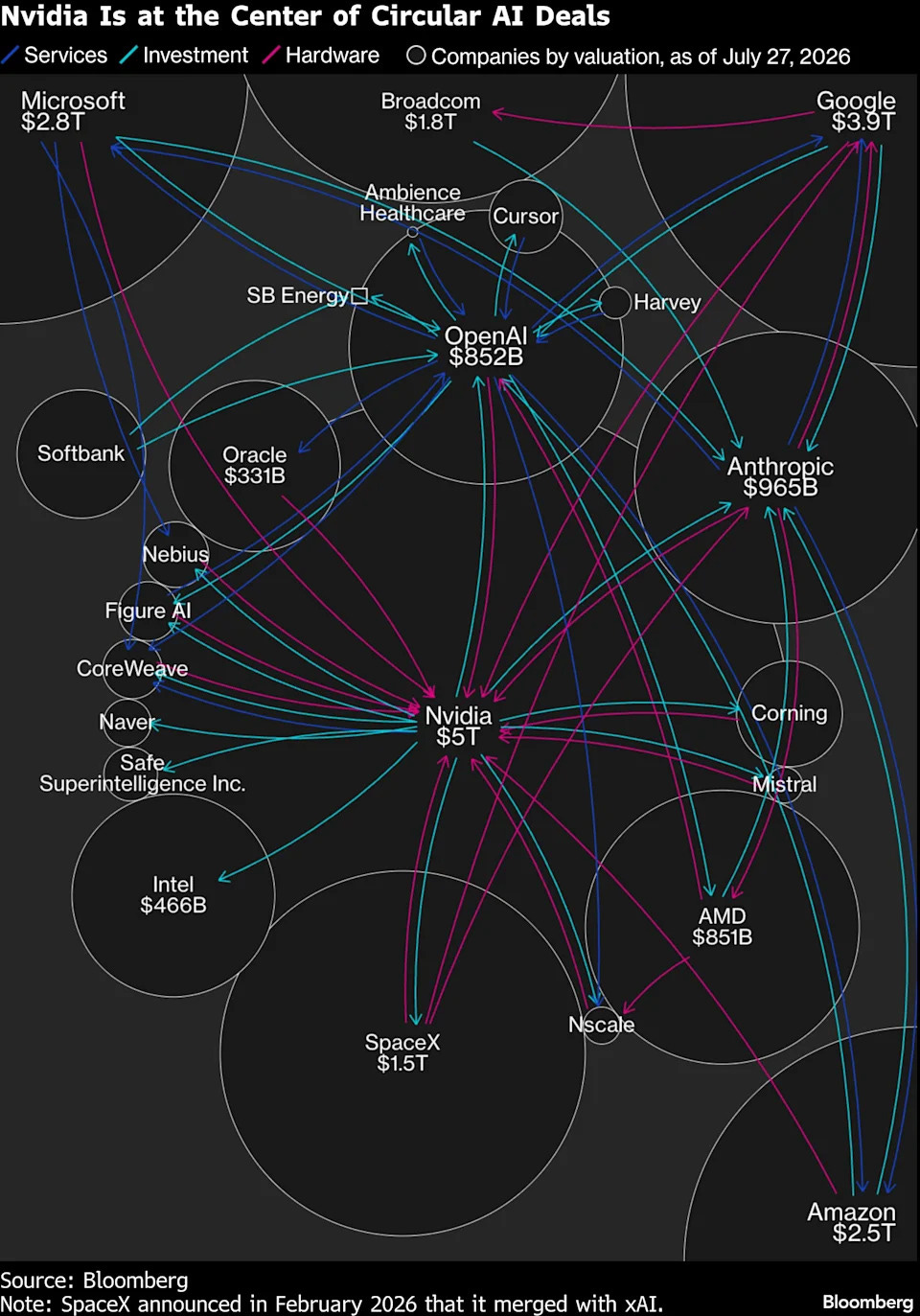
I should say upfront: the thing underneath all this is mostly real. Nvidia sits at a genuine chokepoint, design plus CUDA plus a decade of developer habit nobody else can replicate, and Anthropic nearly tripling in value in three months this spring isn’t pure fiction, there’s real revenue growth behind it. I’m not arguing the technology is fake. The question I actually want to ask is narrower: when a trillion-dollar industry starts financing itself the way it’s currently financing itself, what does that tell you about what the people closest to the money believe, underneath what they say on the earnings calls?
Even the collateral is concentrated
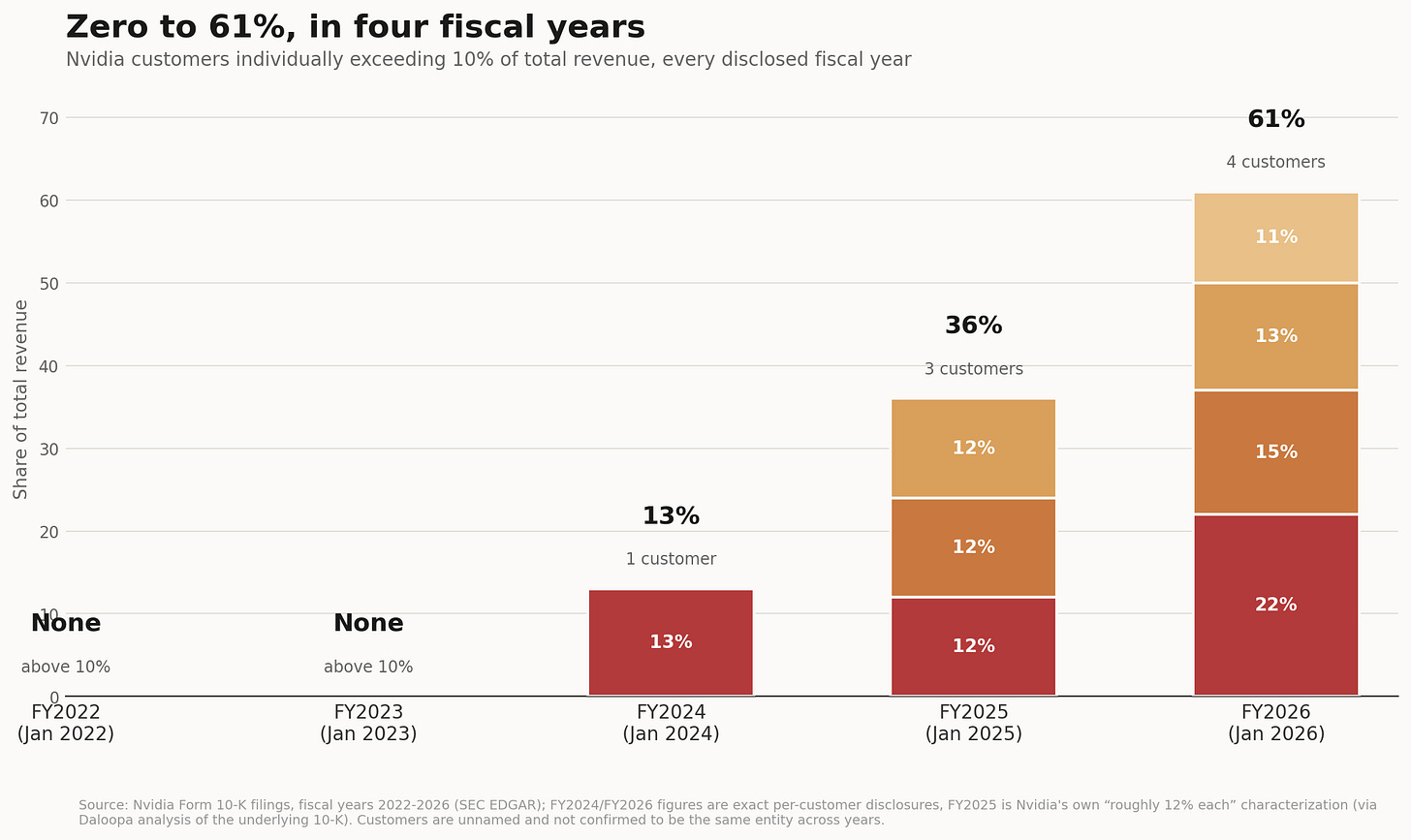
Start with what’s sitting behind Nvidia’s $500 billion deal: the GPUs themselves. And the GPUs are not spread across a healthy, diversified customer base. Nvidia’s own filings show 61 percent of its revenue now comes from four customers. The single largest one is 22 percent on its own. Two years ago, no customer crossed 10 percent.
Three of those four are actively building their own chips specifically to need Nvidia less. Google runs most of its internal AI workloads on its own TPUs already. Amazon has Trainium. Meta has MTIA. None of that necessarily shrinks demand for AI compute overall, the market could keep growing even as Nvidia’s share of it doesn’t. But a $500 billion financing structure isn’t underwritten against compute demand in the abstract, it’s underwritten against these specific chips holding their resale value, sold to these specific customers. The asset managers now agreeing to insure this trade are underwriting a customer base where most of the concentration is actively trying to exit the relationship. That’s the collateral. Wall Street just agreed to price the downside on it.
The same company is on both sides of the check
It gets stranger once you follow where the money for all this is coming from.
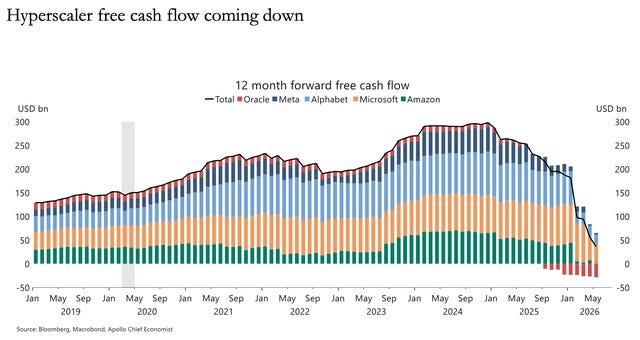
In July, Alphabet posted its first negative free cash flow since its 2004 IPO. Its 2026 capital budget is now $205 billion, more than double the year before. To cover it, Alphabet has raised over $114 billion in debt since the start of 2025, in six currencies, including a 100-year bond, tech’s first since 1997, and it now plans to keep tapping the US bond market twice a year. This is one of the most cash-generative companies in the history of business, and its own operating cash still didn’t cover what it spent that quarter.
Amazon and Google show up again, on the other side of a different trade. Both are simultaneously Anthropic’s largest outside investors and its two largest compute landlords: Anthropic has committed over $100 billion to AWS and $200 billion to Google Cloud, funded in part by capital those same two companies put into Anthropic in the first place. The company writing the check and the company cashing it are, more than once in this picture, the same company wearing two different hats in the same transaction.
I’ve seen this shape before
Here’s where it stops feeling new.
During the telecom buildout of the late 1990s, equipment makers didn’t just sell gear, they financed the customers buying it, then booked that financing as revenue. Lucent extended roughly $8 billion in customer financing. At Nortel, financing offers once reached 130 percent of the purchase price, a company paying its own customer more than the sale was worth, just to be able to say the sale happened. The revenue looked real on the way up. It was the company paying itself to look like demand existed.
Nvidia’s backstop isn’t identical to that, and the difference matters. Instead of lending from its own balance sheet the way Lucent and Nortel effectively did, Nvidia is routing the risk to Wall Street asset managers and only covering a quarter of the downside. That’s a genuinely more careful structure. But the effect is the same effect: a trade that reads as lower-risk to outside capital than the terms underneath it actually justify, terms that only make sense if you already expect some of the underlying loans to go bad. That’s a different animal than routine corporate hedging, which protects against ordinary tail risk and happens constantly without meaning much. Backstopping the loans that buy your own product, at this scale, is closer to a vendor underwriting its own demand.
The credit market already knows
If equity markets haven’t priced this yet, credit markets have started to.
CoreWeave, the AI cloud company that gets 65 percent of its revenue from just Microsoft and OpenAI, is now priced by default-swap traders as carrying roughly a coin-flip chance of default inside five years. Oracle’s cost of insuring against its own default sits at a multi-year high, and analysts now use Oracle’s credit-default-swap price as an informal proxy for how scared the market is about the whole AI trade, not just Oracle specifically. US banks have reportedly started refusing new loans on Oracle-linked data center projects because of how exposed Oracle is to OpenAI’s ability to pay its own bills, and Oracle is now being sued by its own bondholders over how much of that exposure it disclosed.
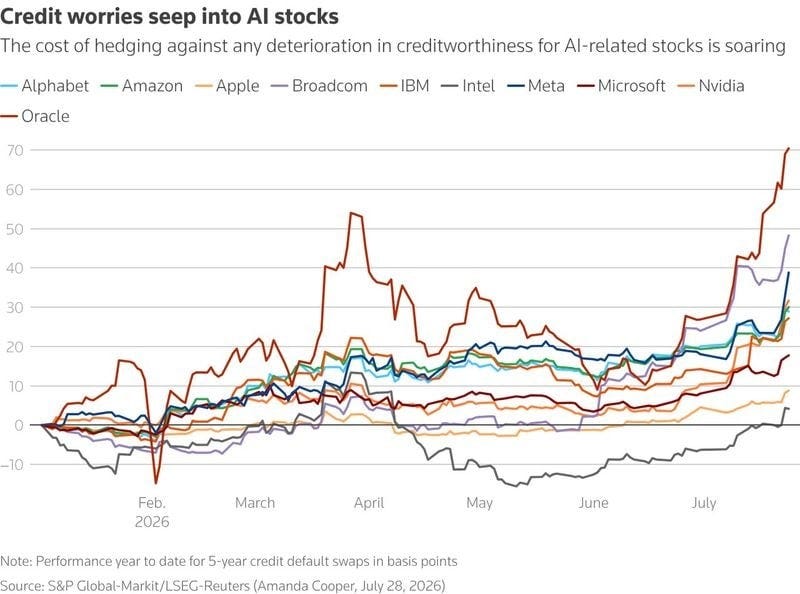
These aren’t identical risks. CoreWeave’s problem is customer concentration, Oracle’s is leverage against a single counterparty’s ability to pay, Nvidia’s is a financing structure built to keep the whole chain moving. But they’re three different problems sitting inside the same loop, and credit markets are increasingly pricing the loop, not just the individual names in it.
Apollo’s chief economist, Torsten Slok, put the actual mechanism plainly this July. The real question is whether financing costs climb high enough that “the marginal data-center dollar no longer clears its return hurdle,” forcing the entire buildout to slow itself down from the inside.
None of that has hit Nvidia’s stock price yet. It’s near its high. Anthropic and OpenAI are both racing toward IPOs that assume trillion-dollar valuations are simply owed to them. But bond and equity markets are, right now, pricing the same handful of companies like they’re looking at two different industries. One is worried about getting repaid. The other is still dreaming about the upside.