India’s Carbon Markets : A New Test for Global Climate Policy
Part one of three on carbon credits, India’s compliance market, and where the money will actually go.
The trigger for this piece was a single line in an industry brief: India’s compliance carbon market, potentially one of the largest in the world, goes live within months. No explanation attached, no sense of why it should matter to anyone outside a regulator’s office. So the starting point was the most basic question possible: what is a carbon credit, actually?
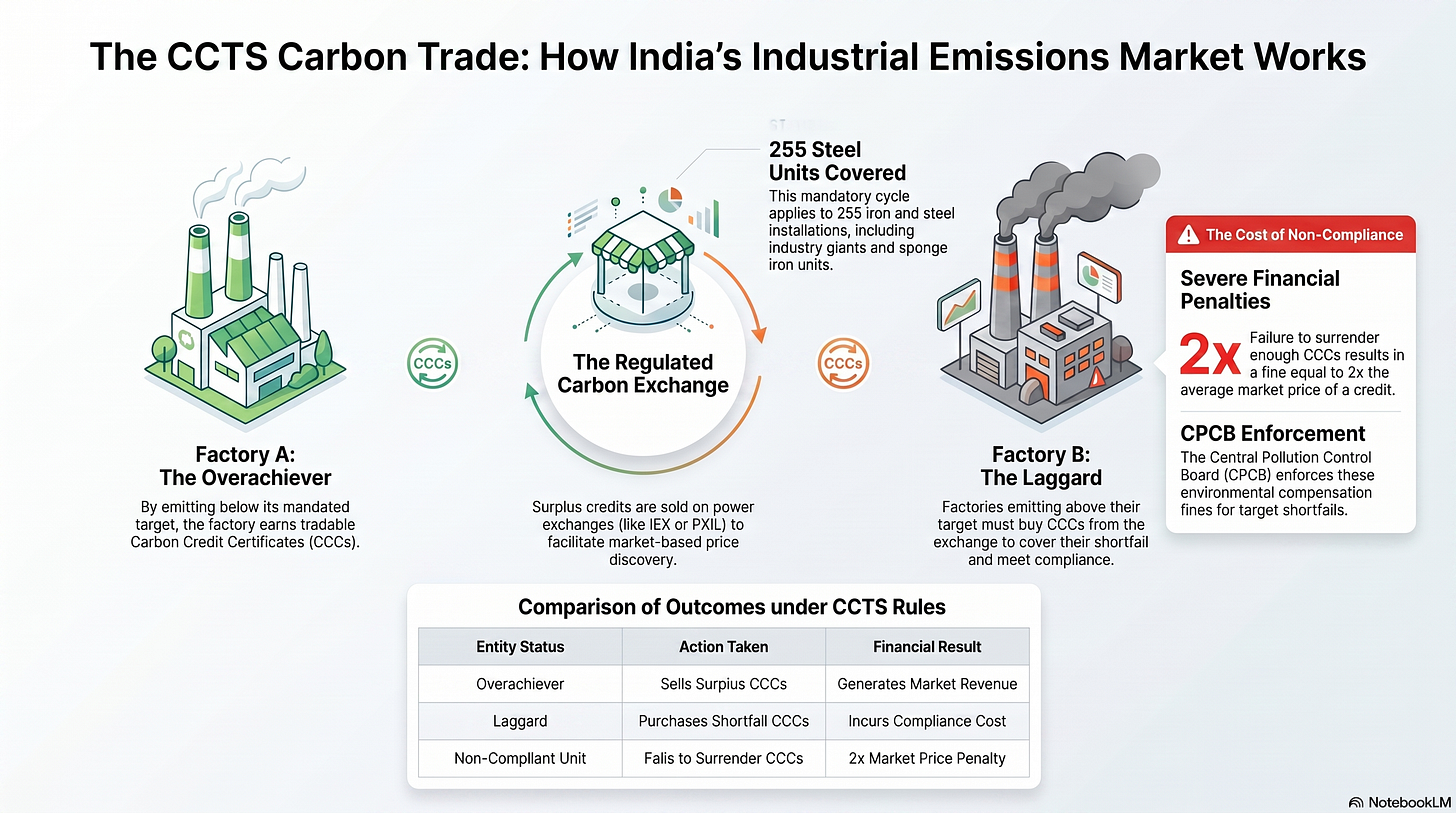
The answer is simple enough. A factory is allowed to pollute up to some limit. Pollute less than that, and the government issues a certificate for the difference. A different factory, about to exceed its own limit, can buy that certificate instead of paying a fine. The certificate is a receipt for pollution that didn’t happen, sold to whoever is about to do too much of it.
That’s the whole trade. Everything else in this industry auditors, registries, exchanges, regulators is machinery built on top of it. And once the trade is that simple, a harder question follows immediately: what stops a factory from lying about how much it saved?
Almost none of the explainers worth reading answer this directly. It turns out to be most of the story.
The market’s real problem was never price
The lying question points straight at the history of these markets, and the history is a warning, not a precedent to be proud of.
In the 2000s, under the Kyoto Protocol’s Clean Development Mechanism, the world tried this exact trade at global scale. Companies built wind farms and hydro plants and sold credits for the coal plants that, in theory, didn’t get built as a result. It worked for a while. Then it fell apart, because a large share of those wind farms would have been built anyway wind power was already getting cheap on its own. The credit represented a reduction that was never actually at risk. Once buyers noticed, prices collapsed and the market never recovered its credibility.
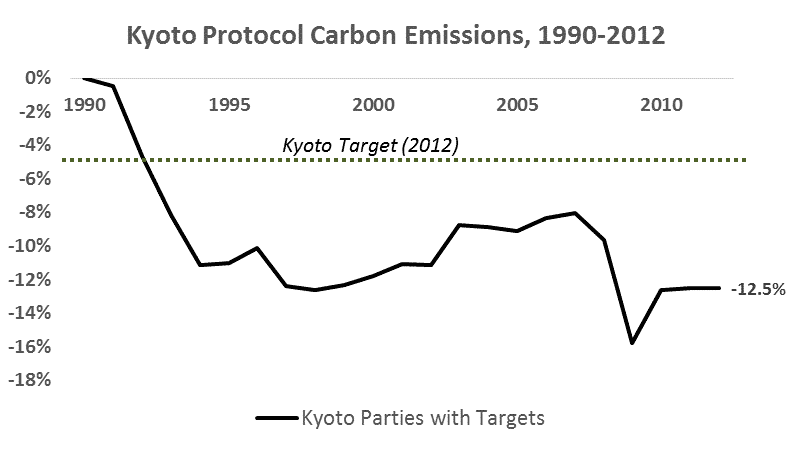
Source: https://circularecology.com/news/the-kyoto-protocol-climate-change-success-or-global-warming-failure
There’s a technical term for this additionality, whether a reduction would have happened without the incentive money but the term matters less than what it exposes. A carbon credit isn’t a physical product. It’s a claim about something invisible. And a market built entirely on unverifiable claims isn’t a market. It’s an honor system, and honor systems don’t survive contact with real money.
Which reframes the whole question this industry has to answer. Not “how do we price carbon,” but “how do we make strangers trust a number enough to trade on it.”
India didn’t start from zero
The natural assumption is that India is building this from scratch. It isn’t, and the reason why is easy to miss unless you go looking for it specifically.
For over a decade, Indian industry ran a scheme called PAT — Perform, Achieve, Trade which set energy-efficiency targets for the country’s largest industrial plants and made them trade certificates depending on whether they hit those targets. It wasn’t a carbon scheme. But it left behind exactly what a carbon scheme needs: roughly a thousand large factories already accustomed to being measured and audited, and a regulator that already knew how to check their numbers and run a trading system around the results.
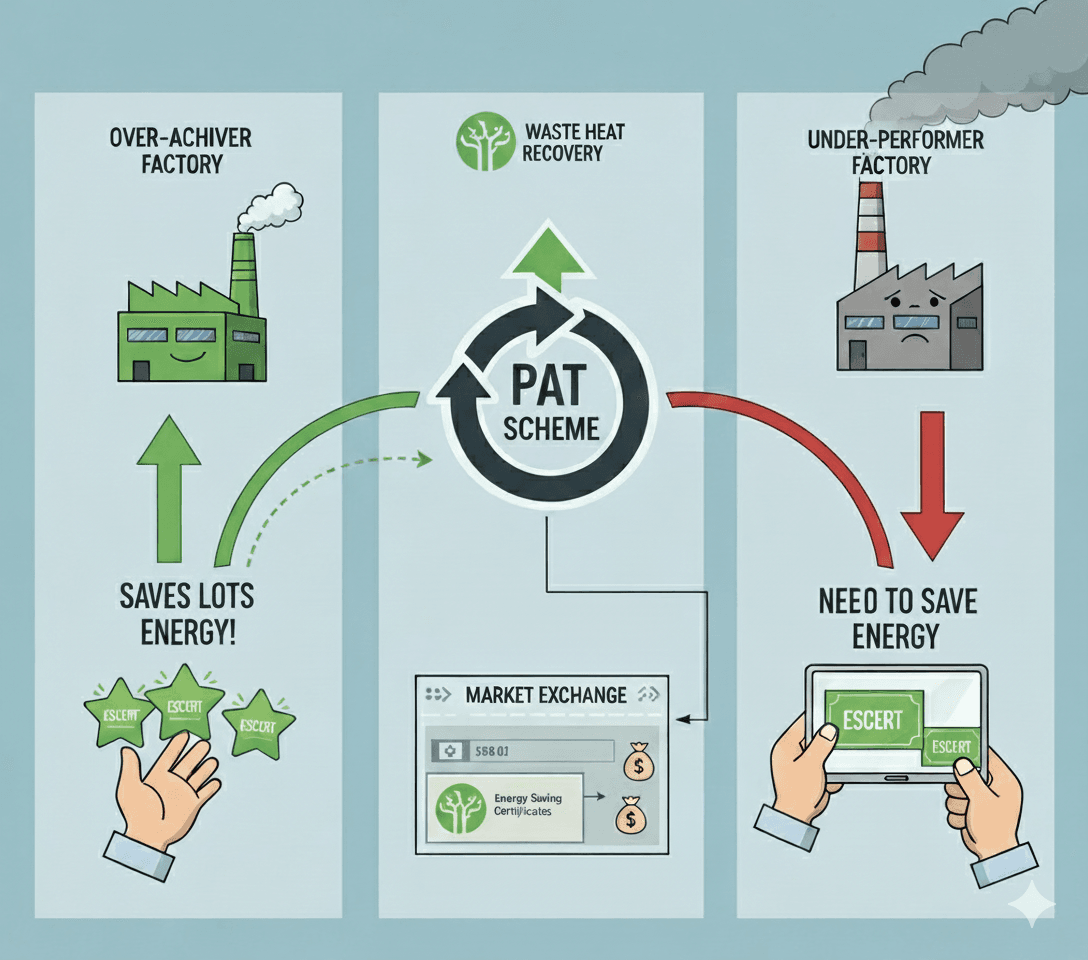
Most coverage of India’s new carbon market treats it as a fresh initiative. The more accurate description is that the hard, boring infrastructure teaching a regulator to audit industrial emissions at scale, teaching factories to report honestly, building the institutional habit of compliance trading was already built, for a different reason, over the previous ten years. India isn’t running an experiment. It’s repurposing one that already worked.
That’s the real answer to “why India, why now.” Not that India suddenly decided carbon mattered more than it used to. It’s that the plumbing was already sitting there.
Two markets sharing one word
A distinction worth getting precise about early, because most casual writing on this topic blurs it: “carbon market” describes two entirely different things.
One is Compliance. A law caps how much a factory may emit, and the factory must buy credits or pay a fine if it exceeds the cap. The other is Voluntary. A company with no legal obligation buys credits anyway, because it has made a public promise and wants proof to point to. Same word, same-looking certificate nothing else about them behaves alike. Compliance demand doesn’t soften when budgets tighten, because the law doesn’t care about a company’s budget. Voluntary demand can disappear the moment a marketing team decides the story isn’t worth the cost this quarter.
The reasonable expectation is that these two markets drift toward each other over time broadly what has happened in other parts of the world, voluntary and compliance credits slowly blending into the same pool of buyers. India’s actual rules do the opposite. They don’t just discourage the merge. They prohibit it. A factory facing a compliance shortfall cannot legally use a voluntary-market credit to cover it.
That looks, on first read, like a technical footnote. It isn’t. It’s a deliberate wall between the market with guaranteed legal demand and the market that depends entirely on goodwill and it’s a decision worth returning to later, once we’ve seen who’s actually trying to sell into each side of that wall.
The double-check that matters more than the exchange
Back to the lying problem, because India’s answer to it is where this stopped being a policy summary and started being genuinely interesting.
Every plant covered by the scheme has its emissions data checked twice by two separate, independent verifiers before a single credit can be issued. If a verifier is caught colluding with the factory it’s supposed to be checking, the regulator can revoke its license outright. Only once both checks clear does a number enter the national registry. Only from the registry can a credit be traded, and only on a regulated exchange private, off-book deals are explicitly banned.
The instinct is to treat the exchange as the centerpiece, since that’s where a price gets set and money visibly changes hands. Reading through how this system is actually built argues the opposite. The exchange sits at the very end, the smallest and simplest step in the whole sequence. Everything upstream of it the targets, the two-verifier check, the registry, the regulator’s review exists for one purpose: to establish that the number is real before anyone is allowed to trade on it.
It’s worth noticing that the exchange is also the only part of this system anyone is likely to photograph screens, tickers, a trading floor. It is very possibly the least important part of the entire apparatus. The part that actually decides whether this market works is the two-verifier check almost nobody outside compliance departments is paying attention to.
The Clock
One date is worth marking. Every plant now covered by the scheme must file audited emissions data for the first time by the end of July 2026, with live exchange trading expected to follow within a few months after. A plant that misses its target and doesn’t buy enough credits to cover the shortfall pays a penalty double the market price a structure deliberately built so that falling short is the single most expensive option available.
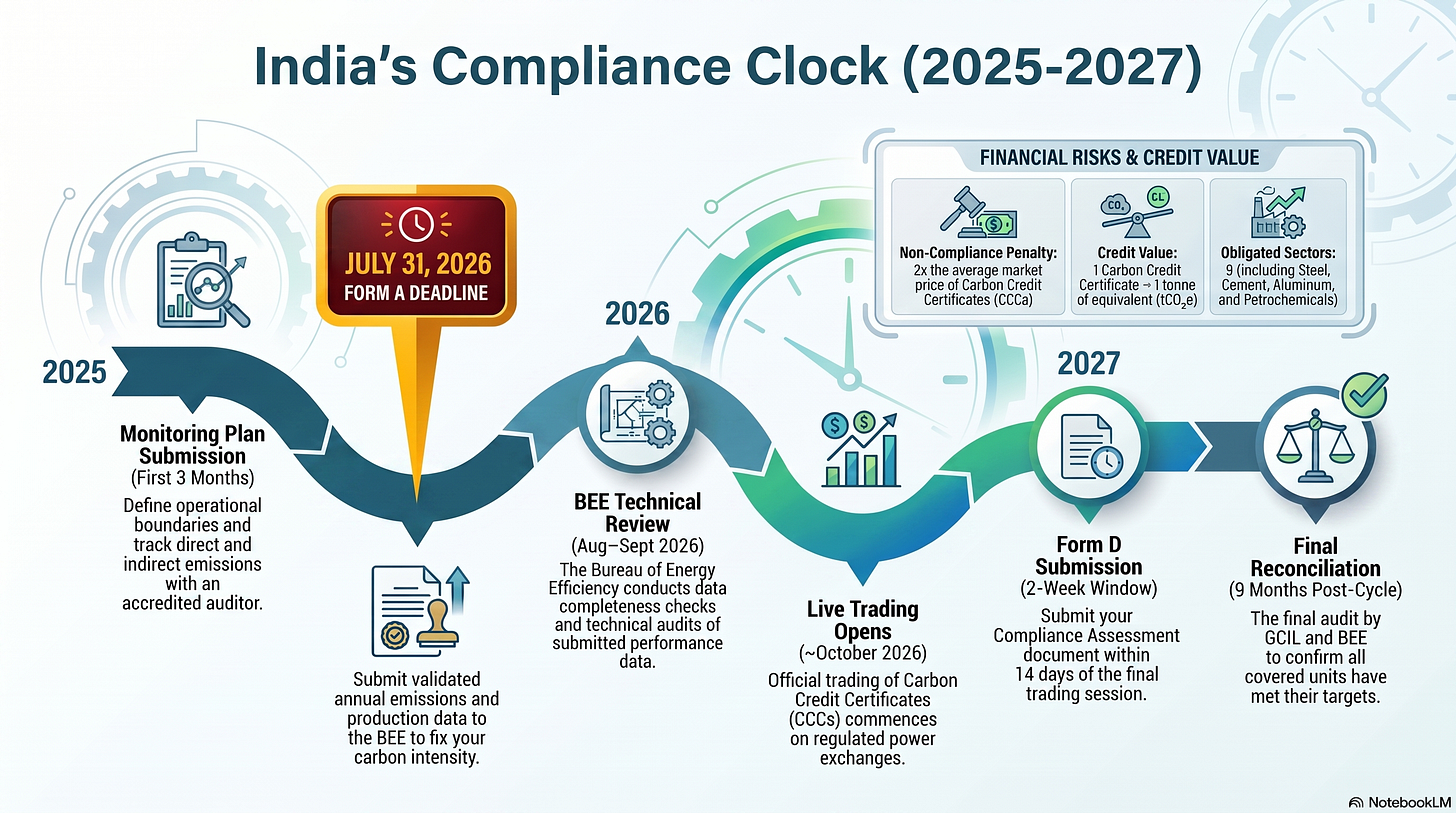
That means this stops being theoretical within the next couple of quarters, not at some vague point later in the decade. Very few people outside a narrow circle of Indian industrial compliance officers appear to be tracking it.
The timing has a simpler explanation than climate ambition
The last piece explains why any of this is happening on this particular schedule, and it comes from trade policy rather than climate policy.
On January 1, 2026, the European Union switched on its Carbon Border Adjustment Mechanism, known as CBAM. In plain terms: selling steel, aluminum, cement, or a handful of other carbon-intensive goods into Europe now triggers a border tariff if those goods were made with more carbon than Europe’s own producers are permitted to emit. The United Kingdom follows in 2027. The United States is debating its own version.
India’s carbon-exposed exports to Europe run into the billions of euros, concentrated heavily in steel. At a high enough European carbon price, the tariff could function like a 25 percent surcharge.
One clause in CBAM changes how everything else here should be read. It allows an exporter to deduct any carbon price already paid at home from the tariff owed at Europe’s border. Which means, for an Indian exporter, a carbon price is coming one way or another. The only open question is who collects it the Indian government, or the European one.
Seen this way, India’s carbon market is not primarily a climate initiative that India chose to adopt out of conviction. It’s a race to keep that money at home before someone else collects it instead. Europe forced the timing. India is trying to make sure it ends up holding the receipt.
What this actually is
Carbon markets have failed twice before, for the same underlying reason each time: nobody could cheaply and reliably prove the receipts were real. India’s version is different not because the ambition is larger, but because it inherited working machinery, a decade of industrial auditing experience, repurposed and because Europe just put a hard deadline on the whole project.
One fact is worth carrying forward, more than any acronym in this piece. Ask where a carbon credit physically exists where it lives, what it’s made of and the honest answer is nowhere. It is an agreement that everyone involved has agreed to treat as real, backed by nothing except the credibility of whoever checked the number.
Which means the question that actually matters was never what carbon will cost. It’s who gets to write the receipt, who gets paid to check that it’s true, and who ends up holding one nobody wants to buy.
The next essay walks the industries actually living this question right now steel, aluminum, cement, power and looks at who is spending real money to get ready, who is quietly stalling, and why those two groups aren’t who you’d expect.