The Wall That Wasn’t Yours
Fable 5 is Anthropic’s best model, but Friday’s letter showed why 'best' doesn’t mean valuable
On June 9, Anthropic’s fable announcement described a Stripe team that pointed Fable 5 at a fifty-million-line Ruby codebase and ran a full migration in a single day. The same task would have taken a whole team over two months by hand.
That is a vendor-sourced single case study, and it should be treated as one. But it describes the specific phenomenon worth paying attention to: a task that costs $250,000 in human time and $5,000 in AI time doesn’t just cut costs it unlocks projects that wouldn’t exist at $250,000. That is the uncapped demand version of this story. It is not the only version.
The demand problem is not what the bears think
The bear case on frontier AI spending has two versions. Version one: the productivity gains are fake, it’s all Goodhart’s Law, engineers gaming token leaderboards with make-work agents while COOs go looking for value and find none.
But that version describes a specific failure mode: metrics that reward usage rather than outcomes. It doesn’t describe Stripe running a genuine migration, or Anthropic’s run rate climbing from $9 billion a year ago to $47 billion, a trajectory Ben Carlson documented in June 2026 that doesn’t emerge from fake engagement.
The distinction that matters is whether the task is capped or uncapped. Routine coding work the marginal feature, the iterative bug fix may be capped. Microsoft, by one account, pulled Claude Code licenses from an entire division when the compute cost exceeded the cost of the people it was meant to help. Capped market, margin compression, no new demand created. The Stripe migration is different: it unlocked a project that wouldn’t have been approved at human-labour cost. That is genuine new demand.
The question is what fraction of real AI enterprise spending looks like Stripe and what fraction looks like tokenmaxxing. That ratio is genuinely contested, and anyone telling you the answer with confidence is selling something.
The business model is closing an obvious incoherence
On June 23, Fable 5 was scheduled to leave Anthropic’s flat-rate subscription plans. Want the best after that date: pay metered API credits, $10 per million tokens in, $50 out.
For two years, flat-rate subscribers on the $200 Max plan were extracting $600 to $1,500 per month in token-equivalent compute. The head of Claude Code called the economics “really hard to do sustainably.” GitHub made the same correction on June 1, shifting Copilot from flat-rate to usage-based billing; one developer’s projected monthly cost moved from roughly €67 to €966.
A subscription business monetises engagement shallowly the cost of each interaction is variable while the price is fixed. A metered API business monetises the Stripe migrations directly. The transition is closing an obvious incoherence. Whether it re-accelerates Anthropic’s revenue trajectory depends on how much of that $47 billion run rate was built on genuine uncapped demand versus subsidised usage a number the IPO filings will eventually force into view.
The open source ceiling
In April 2026, a free downloadable model called GLM-5.1 climbed to the top of SWE-bench Pro, the benchmark Fable 5 now leads. It held the crown for nine days before Anthropic shipped Opus 4.7 and the lead was gone.
This is the tempo of the market. Ramp’s enterprise spend data shows the average cost per million tokens fell from roughly $10 to $2.50 in a single year. Economist Luis Garicano, makes the structural case that intense competition and near-zero switching costs mean most surplus flows to customers not to model providers while upstream bottlenecks like TSMC and Nvidia hold the scarcity rents. Switching providers is a configuration change. No installed base. No data gravity. No retraining cost.
The model provider in the middle gets squeezed from below by open source and from above by the infrastructure layer. This was the bull case for pure model plays: build the moat fast enough to escape that squeeze before the ceiling descends.
The wall Anthropic built
Fable 5 ships with safety classifiers that specifically reroute distillation queries to Opus 4.8. Distillation queries are prompts engineered to extract a frontier model’s reasoning patterns — the exact mechanism by which smaller open-weight models are trained to approximate expensive frontier ones. The locked-down twin, Mythos 5, sits behind individual vetting in Project Glasswing, inaccessible to any public API. You cannot distil what you cannot access.
This is a deliberate attempt to break the commoditisation pipeline at its source. The wall slows imitation — it does not prevent it, because open-source labs have routes through reinforcement learning, synthetic data, and model merging that don’t require Anthropic’s outputs. But it buys time. And the real moat may not live in the weights at all: enterprise integration depth, compliance certifications, security audits, workflow dependencies. AWS and Salesforce became enormous businesses without unassailable technology. What they held was operational embeddedness switching costs that rose not because the product was irreplaceable, but because it was structurally woven in.
Anthropic might win the margin race even if open-source closes the capability gap. The question is whether it uses the current frontier window to embed deeply enough before the pricing floor arrives.
That was the thesis as of Thursday.
A letter arrived at 5:21 PM
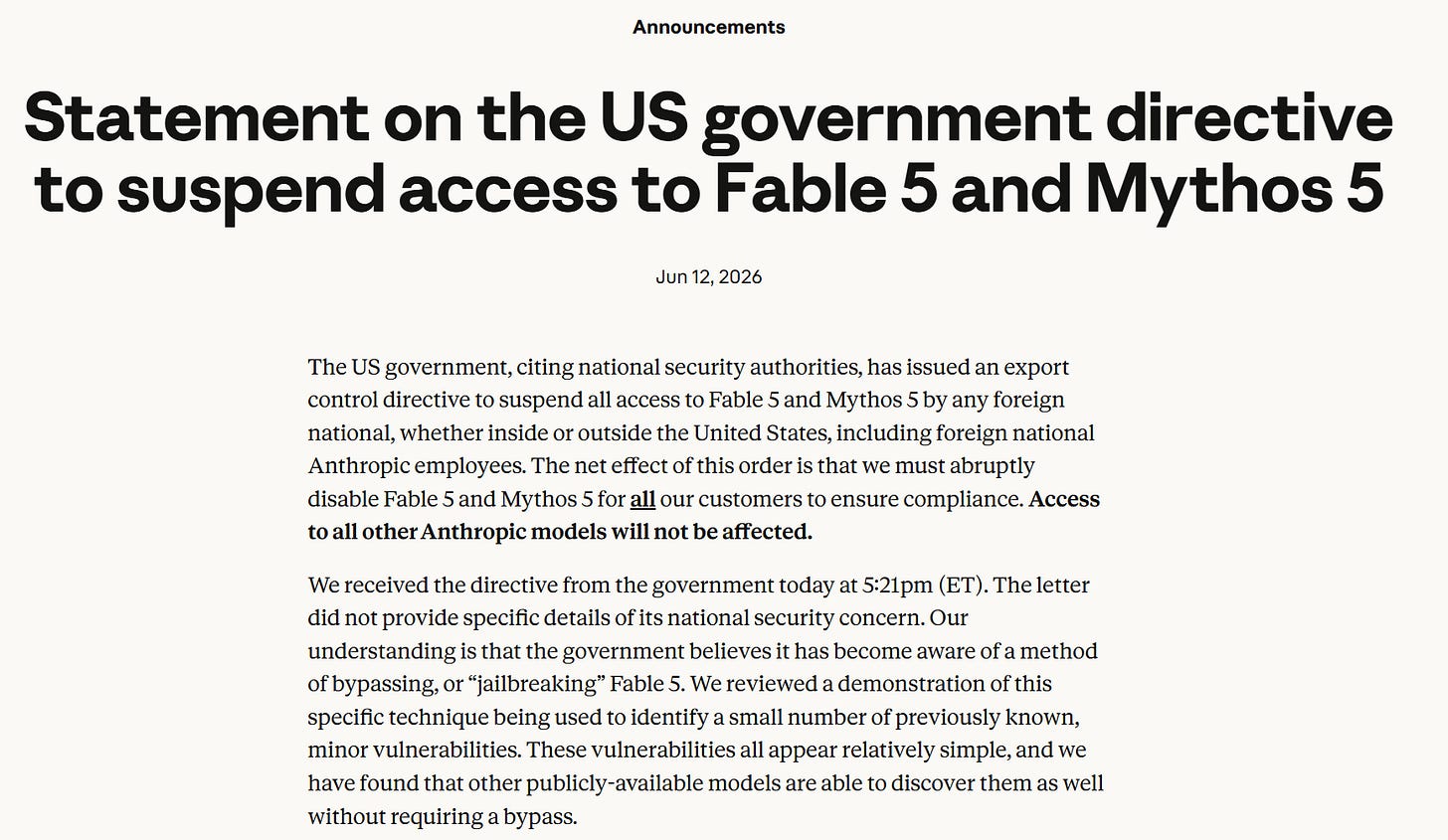
At 5:21 PM on Friday, June 13, a directive arrived from Howard Lutnick’s Commerce Department. It required Anthropic to immediately suspend all access to Fable 5 and Mythos 5 for any foreign national whether inside or outside the United States, including Anthropic’s own foreign national employees.
Anthropic had no reliable way to verify which users were US citizens and which weren’t. So they turned it off for everyone.
Not degraded. Not restricted. Gone.
There is credible reporting that this is partially political retaliation. The Pentagon had labeled Anthropic a “supply chain risk” after Anthropic refused to remove its acceptable use restrictions on autonomous lethal weapons and mass domestic surveillance. A federal judge in San Francisco temporarily blocked that designation, finding Anthropic likely to succeed on its First Amendment retaliation claims and writing that the government’s measures “appear designed to punish Anthropic.” Friday’s Commerce directive looks like the administration finding a different lever.
The political context matters but doesn’t change the structural point. Anthropic’s safety narrative gave the government a workable justification: when you spend months publicly arguing your model is uniquely dangerous, you provide the framing that a national security directive requires. Anthropic’s own pushback noted that the demonstrated jailbreak found vulnerabilities “widely available from other models including GPT-5.5” their strongest legal argument, and simultaneously a damaging self-disclosure about the product’s claim to singular danger.
The third variable
This is the variable that was missing from every bull and bear case on frontier AI.
The question was whether model providers capture Nvidia-like margins or get competed down to airline economics. Friday introduced a third option: the government turns it off.
This is not unprecedented export controls on 40-bit cryptography in the 1990s, the PlayStation 2’s GPU export restrictions, ITAR applied to dual-use software. In each case: real capability, real controls, controls eventually obsolete, delay real in the meantime.
For enterprises, what changed on Friday is categorical. A key vendor changing pricing or going out of business is a known risk category. What became empirical on Friday is different: a US government letter, with four hours’ notice, can zero out production infrastructure. Anthropic’s own statement warns that “if this standard was applied across the industry, we believe it would essentially halt all new model deployments for all frontier model providers.”
For investors the implications compound. Pure model plays now face squeezed margins from open source and a regulatory overhang that closed-model providers can’t price away. Infrastructure plays the hardware layer, the energy layer, the open-weight labs look structurally cleaner.
Large enterprises will solve the compliance problem they have lawyers and compliance teams for exactly this, and multinationals operating across dozens of countries will find ways to route around a citizenship-verification requirement that is practically unenforceable at the query level. What they won’t do is un-see the precedent. Sovereign AI goes from cautious CIO talking point to line item in the next procurement cycle. The immediate disruption gets resolved. The strategic calculation doesn’t.
The revised question
There is a version of Friday that resolves quickly. Anthropic fights in court, the administration walks it back, Fable returns behind some form of compliance framework, and the metered transition happens on a delayed schedule. That is probably the most likely outcome.
But the precedent is set regardless. You cannot un-demonstrate that a US government directive can shut down a frontier model in four hours. Smart players were already hedging. This makes hedging table stakes.
Frontier AI isn’t purely a market good anymore. It’s strategic infrastructure with government oversight.
Anthropic built the anti-distillation wall. They embedded the classifiers. They gated Mythos behind individual vetting. They built the most elaborate moat in the industry around capabilities they had described as uniquely dangerous.
The letter arrived anyway.
The wall they built was real. It just wasn’t the only wall in the room and they didn’t get to choose which one enclosed them.